Author Archive for Thomas Slatin

Tips To Improve Your Grunge Photography

If you want to improve your grunge photography, allow these simple tips and tricks to help you find interesting subjects, compose your shots, and if nothing else, inspire you.  I have assembled some of my best tips and tricks that can be used not only for grunge photography, but other photographic styles as well.

The End Of The Road

Take The Road Less Traveled

Instead of traveling the same road that everyone else travels, make your own way. Most of the abandoned and grunge photos I have taken are the direct result of taking back roads, and avoiding highways. Every small town will always have at least one ghost road, at least one abandoned building, and generally a handful of friendly people who will be more than happy to suggest places that a photographer might be interested in. When in doubt, ask someone who lives or works in the area; those with a lot of local knowledge will be most helpful.

This photo was found at the end of a dirt road. It is also important to geotag your photos, especially if you add them to Flickr so that others can see where the photo was taken (more on this later).

The Life They Let Slip Away (Holga Edit)

Don’t Overlook The Details

Or as they say, the proof is in the pudding. Instead of just taking photos of grand places, shoot the details. While I was exploring an abandoned house, I came across a room filled with trash and neglected toys. Just as I was about to leave, I came across this old doll laying on the floor behind an open door. After taking several shots of this doll, this one was by far my best shot of the day, and perhaps one of my most talked about and coveted photos.

Empty House 1 - 1

Do Your Research

In other words, know before you go. I originally planned to visit the abandoned town of Centralia, Pennsylvania. After talking to some local folks, I was referred to Ashland instead, which was a neighboring town with lots of abandoned places. I came across this abandoned house; it looked small from the front, but looks can sometimes be deceiving. It ended up being a multi-family dwelling with some sort of car repair shop in the back.

Old Phone

Trash Can Be Pretty

The mark of a good photographer is the ability to take a picture of something nobody cares about, might find uninteresting or is just plain unattractive, and turn it into a priceless shot. One of the best groups on Flickr is called clutter, litter, mess and muddle.  I found this old telephone on top of a pile of discarded trash.  The fact that it was raining at the time the shot was taken added to the mood and made the lighting even more interesting.

Roller Skates

Look For Patterns

I decided to spend some time at a skating rink following a birthday party I was photographing.  At closing  time, I watched about 100 people drop their skates in front of the skate rental counter.  I took this picture as the staff went around picking up the pairs of skates one by one as they were put back on the shelves.

Geotag Your Photos

Flickr has an amazing mapping feature that I believe is not used nearly enough.  If you go to the Map Page on Flickr, you will be shown an interactive map of where photos were taken.  Not only is this a great way to view new and interesting places and photographs, but it can also be a useful tool to research places to take photos. Above all else, one of the best ways to share your grunge photography and/or urban exploration photos is to disclose the location where it was taken.  I try to geotag the photos I take whenever possible, except sometimes when the location needs to remain undisclosed to protect the property or to protect myself from possible litigation by the property owners, be it current and/or future.

Here are a handful of related Flickr groups worth a look:

I should probably also mention this guys blog… Jacques has a fascinating collection of urban exploration photograpy, and his blog is entertaining, inspiring, and resourceful.

Secrets of Lo-Fi Photography

between an erupting earth and an exploding sky
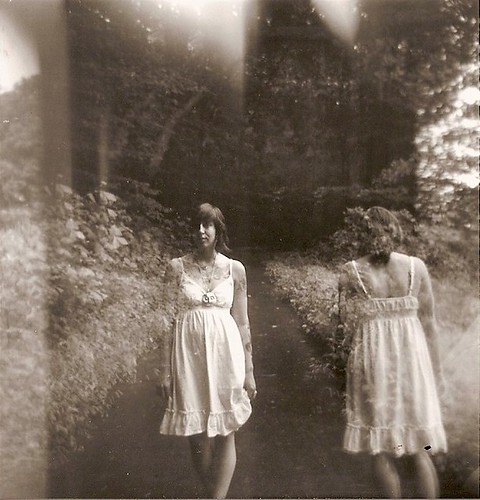
Between An Erupting Earth And An Exploding Sky by Ashley Buress, Used With Permission.

Lo-fi photography is a style of photography generally using poor equipment, such as toy cameras or pinhole cameras, for stylistic effect. It is often considered a reaction to the perceived ease of creating technically perfect photos in the digital age. Generally the emphasis is on using film, rather than digital technology.
–Wikipedia

The LaundromatPop CornSave-A-LotUnleaded $3.239

Recently, I learned an important lesson about photography.  The camera does not make the photograph, the photographer does.  This concept has been intentionally dismissed by camera companies who insist that you need the latest, most high-tech, and expensive camera gear to create beautiful images.  Recently some photographers have become late adopters to the idea that beautiful images can be created with outdated and sub-standard camera gear.  Sadly, with the era of digital photography, film cameras are now slowly being considered lo-fi, as are Polaroid instant print cameras.

Perhaps the most notable lo-fi cameras include Dianas, Holgas, Lomos, and as far as digital is concerned, very low megapixel digital cameras.  The featured image at the very beginning of this article was provided for use by Ashley Buress, whose Flickr photostream (at the time of this writing) was almost completely filled with some very impressive lo-fi photography.  The remainder of the photos in this article were taken by me, using my Blackberry Curve 8530.

Stone PonyOld Man At The CounterNapkins Over The Parking LotThe Old General Store

Despite the artistic appeal of lo-fi photography, it can also have some practical uses.  A lot of folks feel the idea of carrying around a DSLR everywhere you go is a practical idea, however cell phones have become a vital accessory of modern life.  With the advent of camera phones (cellular phones with built-in cameras), the ability to have a camera with you at all times suddenly appeals to quite a lot more people.  As I mentioned earlier, the photos in this article were taken with a camera phone, which at roughly 2 megapixels, it qualifies as a lo-fi camera by todays standards.

It never ceases to amaze me how those with simple low-end cameras always dream of having the latest high-end cameras of their well-to-do counterparts.  And yet, even more amazing are the photographers who own the high-end equipment who look to those with toy cameras for advice on how to make their photographs look as if they were taken with lo-fi equipment.

The good news is that if you are lucky enough to own a modern DSLR, chances are you can step-down the resolution of your final image.  In other words, instead of your camera producing a 10 megapixel image, most modern DSLRs will allow you to set the resolution down to 5 megapixels, 2 megapixels, or further down.  Alternatively, there are a lot of people making a small fortune by selling Photoshop Actions that simulate lo-fi photography.

My photographic passion is grunge photography.  In future posts, I’ll discuss ways of turning high-end digital photographs into photographs that look as if they were taken using lo-fi cameras.

High Contrast Grunge Photography

High Contrast Grunge Photography takes the look of traditional Kodalith darkroom prints to the digital era (or for those of you still shooting with film, and developing in a darkroom, keeps Kodalith alive). By the way, there is a Kodalith group on Flickr!

Old Sneakers

Read More→

The Exploration of Aiden Lair Lodge

During a recent drive through the Adirondacks, I came across this abandoned lodge along route 28N in Minerva, New York. A sad reality exists, especially in the United States that many historical buildings and places are being left to decay, alone in their own abandon. Ideally places like this would be preserved somehow as part of our own American history.

The following photographs document the current state of just one of many such places that despite their historical significance and importance, are being left to rot and decay, forgotten by all but the most curious of people, like me, who stop in for a closer look, before it’s lost and gone forever. Ideally, I’d like to think that my photographic documentation of abandoned places such as this will raise some much needed awareness and possibly lead to some preservation efforts. The photos presented here can also be seen here, on Flickr.

A Little Privacy Please

Polaroid: Lo-Fi At An Instant

The instant camera is a type of camera that generates a developed film image. The most popular types to use self-developing film were formerly made by Polaroid Corporation.

The invention of modern instant cameras is generally credited to American scientist Edwin Land, who unveiled the first commercial instant camera, the Land Camera, in 1948, a year after unveiling instant film in New York City. The earliest instant camera, which consisted of a camera and portable darkroom in a single compartment, was invented in 1923 by Samuel Shlafrock.

In February 2008, Polaroid announced it would discontinue production of film, shut down three factories and lay off 450 workers. Sales of chemical film by all makers have dropped by at least 25% per year in the first decade of the 21st century, and the decline is likely to accelerate. Fujifilm is now the only remaining supplier of instant film in the United States. However, in October 2009, Polaroid announced it would bring back its classic instant film cameras, after announcing the year before that production was to be stopped.
–Wikipedia

Since the era of digital photography becoming mainstream, the use of traditional film and instant cameras has become less common. With few exceptions, it seems that most photographers are turning to digital cameras, computers, and electronic printers; everything that was commonly found in a darkroom has now been replaced with digital equipment. Although digital equipment has many advantages such as lower cost, higher productivity (batch processing, automation, etc.), and ease of use, old-school film and instant formats still remain popular among some photographers.

A friend of mine on Flickr named Ashley Burress, is one of the few photographers who refuse to succumb to the all-digital fad, and who is still an instant print enthusiast. She gave me permission to use her Polaroid photographs as part of my article in exchange for a link to her blog and mention of her Flickr photostream. Most recently, Ash has posted a collection of instant photographs from a recent trip to The Nashville Zoo, which are a must see. All of the photographs presented here are Copyright Ashley Burress, and used with permission.

Read More→

The Exploration Of Old Lodge

Front Outside View

Old Lodge is a 10,000 square-foot building built circa 1890, built in Tomkins Cove, New York. Over the years it was used as a hotel, a private school, a girl scout camp, and private residence. There are unconfirmed reports that the building was used as a nursing home for a short period of time. Years of neglect and decay have left it as a ‘shell’ of a building, and as such it has been formally condemned and entry to the building is strongly discouraged and extremely dangerous. Read More→