Archive for holga

Secrets of Lo-Fi Photography

between an erupting earth and an exploding sky
Between An Erupting Earth And An Exploding Sky by Ashley Buress, Used With Permission.

Lo-fi photography is a style of photography generally using poor equipment, such as toy cameras or pinhole cameras, for stylistic effect. It is often considered a reaction to the perceived ease of creating technically perfect photos in the digital age. Generally the emphasis is on using film, rather than digital technology.
–Wikipedia

The LaundromatPop CornSave-A-LotUnleaded $3.239

Recently, I learned an important lesson about photography.  The camera does not make the photograph, the photographer does.  This concept has been intentionally dismissed by camera companies who insist that you need the latest, most high-tech, and expensive camera gear to create beautiful images.  Recently some photographers have become late adopters to the idea that beautiful images can be created with outdated and sub-standard camera gear.  Sadly, with the era of digital photography, film cameras are now slowly being considered lo-fi, as are Polaroid instant print cameras.

Perhaps the most notable lo-fi cameras include Dianas, Holgas, Lomos, and as far as digital is concerned, very low megapixel digital cameras.  The featured image at the very beginning of this article was provided for use by Ashley Buress, whose Flickr photostream (at the time of this writing) was almost completely filled with some very impressive lo-fi photography.  The remainder of the photos in this article were taken by me, using my Blackberry Curve 8530.

Stone PonyOld Man At The CounterNapkins Over The Parking LotThe Old General Store

Despite the artistic appeal of lo-fi photography, it can also have some practical uses.  A lot of folks feel the idea of carrying around a DSLR everywhere you go is a practical idea, however cell phones have become a vital accessory of modern life.  With the advent of camera phones (cellular phones with built-in cameras), the ability to have a camera with you at all times suddenly appeals to quite a lot more people.  As I mentioned earlier, the photos in this article were taken with a camera phone, which at roughly 2 megapixels, it qualifies as a lo-fi camera by todays standards.

It never ceases to amaze me how those with simple low-end cameras always dream of having the latest high-end cameras of their well-to-do counterparts.  And yet, even more amazing are the photographers who own the high-end equipment who look to those with toy cameras for advice on how to make their photographs look as if they were taken with lo-fi equipment.

The good news is that if you are lucky enough to own a modern DSLR, chances are you can step-down the resolution of your final image.  In other words, instead of your camera producing a 10 megapixel image, most modern DSLRs will allow you to set the resolution down to 5 megapixels, 2 megapixels, or further down.  Alternatively, there are a lot of people making a small fortune by selling Photoshop Actions that simulate lo-fi photography.

My photographic passion is grunge photography.  In future posts, I’ll discuss ways of turning high-end digital photographs into photographs that look as if they were taken using lo-fi cameras.

Review: Holga HL-N Lens for Nikon DSLR Cameras

I am a sucker when it comes to darn near anything retro. Old cars, older video games, bad sci-fi movies from the 80s, and vintage photos are all on that list of things that will stop me in my tracks too take a moment and enjoy. For this article, I’m focusing on my love of old photos. There is something about a grainy, scratched, vignetted, and overall imperfect photo from the past that really floats my boat. Perhaps this is why so many of my photos are trying to replicate aspects of this retro look.

The camera that tends to be the culprit of growing retro style photo popularity is the Holga film cameras. These are cheap plastic cameras that take some great photos with vignettes, light leaks, multiple exposures, and so much more. The issue is that you always had to buy these “toy” camera bodies and film to enjoy the Holga effect. That is until recently!

Holga has released two lenses that are specifically made to fit the Nikon and Cannon DSLRs. The HL-N is, obviously, for the Nikon while the HL-C fits a Cannon. These lenses promise great Holga effects with the convenience of your digital camera. When I heard about this, I immediately jumped all over the opportunity to snag the HL-N and take it for a spin.

When I received the box with my HL-N, the first thing I noticed was how extremely light the box was. I have ordered small Lego sets that weighed more than this. The reason for this lightness is due to the Holga lens being made out of plastic with the exception of the small front piece of glass. There are a few holes drilled out on the back to send the image to the sensor, but that is it. Even the part that mounts to your cameral is plastic. This truly brings the toy camera feel right to the DSLR world. Read More→

Lomography 101

Lomography emphasizes casual, snapshot photography. Characteristics such as over-saturated colors, off-kilter exposure, blurring, “happy accidents,” and alternative film processing are often considered part of the “Lomographic Technique”.
–Wikipedia

A lomographic camera is perhaps the pinnacle of grunge photography. Similar to the Holga, the Lomo camera produces unique results that are unique and specific to each individual camera. Specifically, the Lomo will typically produce images that are of selective focus, over or under exposure, indense off-center vignetting, and over saturation.

Shown here is an example of an actual photo taken with a Lomographic camera using a fisheye lens.

Read More→

Easy Do-It-Yourself Holga Effects

In a previous post, I discussed the joys of taking photos using a Holga Camera.  For those of us who have already crossed into the digital divide, there are still ways of making your digital photos appear as if they were taken with a real Holga camera.  While there are countless actions available for Photoshop that will give our photos that ‘holga look’ automatically, the real test of ones ability is to be able to perform these post-production edits ourselves.  One of the main benefits of doing editing manually is that each image will have it’s own unique edits, just like a real Holga camera, instead of a macro, where every image gets the same cookie-cutter treatment.

This tutorial will show you how to render Holga-like effects that are unique to each individual image using free software.

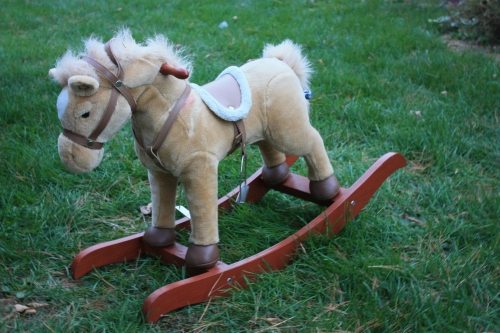
What You Need – You will need to download a copy of Paint.net, which is available for free.  In case you aren’t familiar with Paint.net, it is a free [very basic] clone of Photoshop.  We’ll start with this plain snapshot of a toy rocking horse.  Feel free to download this image if you wish, but please DO NOT post this image, or your final image on the internet (if you used the above photo).  Images you create using this method using photos you took should be posted online, and I encourage you to do so!

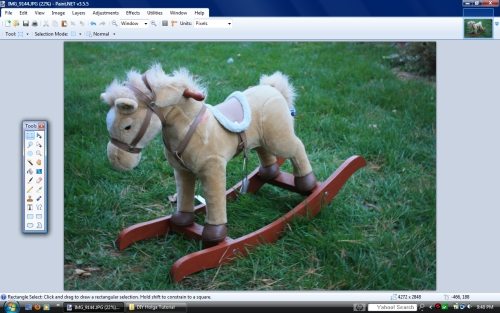
Step 1 – We will open the rocking horse photo with Paint.net.  Throughout this tutorial, the images shown are smaller than actual size to save layout space.  Click the images for a larger view (opens in a new window).

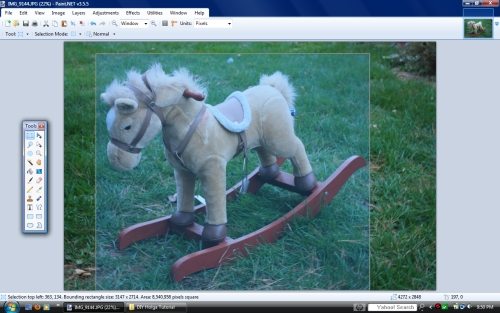
Step 2 – Now that we have the file open with Paint.net, we will first need to crop it as squarely as possible.  To create an exact square crop, hold down the shift key.  I have cropped this image somewhat (i.e. not exactly) squarely, which is more representative of a true image taken with a holga camera.

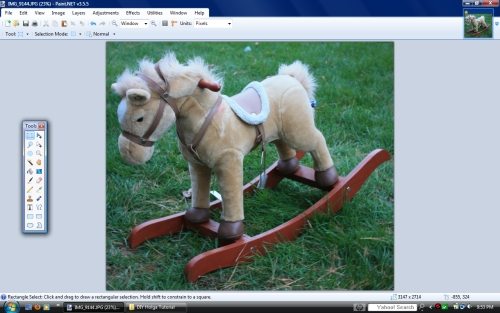
Step 3 – This is what your image should look like now that the image has been cropped.

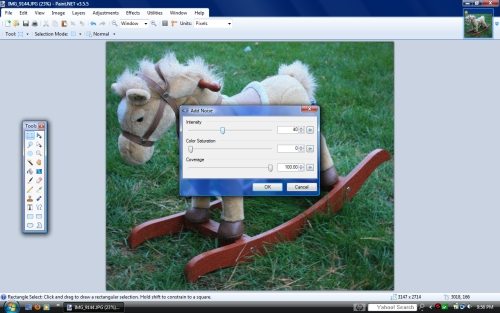
Step 4 – Add noise.  Go to Effects > Noise > Add Noise.  Set the Color Saturation to 0, and the coverage to 100.  The intensity is yours to determine.  Try moving the slider back and forth until you find the amount that works best for your image.


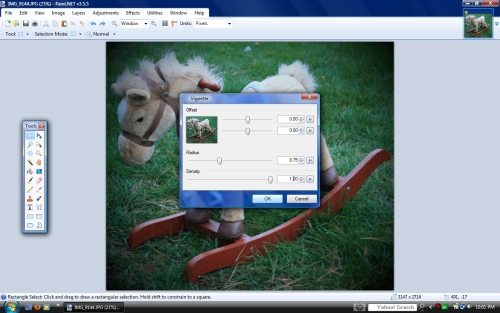
Step 5 – Add the vignette.  Go to Effects > Photo > Vignette… Set the intensity at 1; adjust the radius accordingly.  For the ultimate Holga effect, set the offset just off center, and change the values randomly slightly off center with each and every photo you edit.

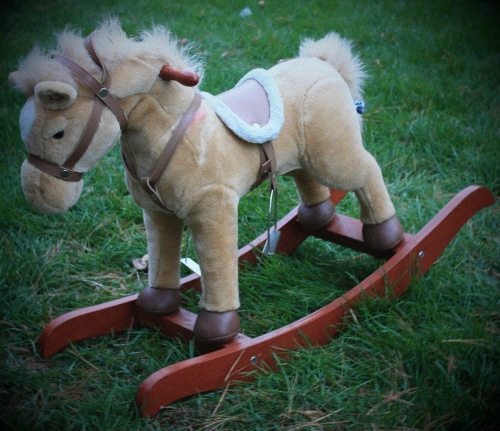
This is the final, finished image.  The last [optional] step is to adjust the brightness and contrast, but remember that a Holga camera has a fixed aperture and no light meter, so it is not unusual to get imperfect exposure.  Be sure to save your image, and share it for others to admire.

More examples of Holga Effects I’ve created using the above method…

Strasburg Railroad Water Tower Wide Open Spaces Stop - Look - Listen The Not-So-Great Divide (Holga Edit) Beach
Rocking Horse

Everything You Ever Wanted To Know About The Holga


The Holga is a medium format 120 film toy camera, made in China, known for its low-fidelity aesthetic. The Holga’s low-cost construction and simple meniscus lens often yields pictures that display vignetting, blur, light leaks, and other distortions. The camera’s limitations have brought it a cult following among some photographers, and Holga photos have won awards and competitions in art and news photography.
–Wikipedia

Back in the days before I had the money to invest in a high-end digital SLR camera, I would spend long nights, sometimes hours at a time in the darkroom, developing that days film. I was addicted to 35 mm film, especially black and white. I clearly remember reading about the Holga on the Internet, and I just had to have one.

About The Holga

For those of you who may not be familiar with the Holga camera, it is marketed as a toy, but for those who have ever taken photographs with one, it is anything but a toy. The Holga camera uses 120 mm film, which is many times larger than the common 35 mm film that is most popular in the United States, and instead of having around 30 exposures per roll with 35 mm film, the Holga’s 120 mm film yields between 12 and 14 exposures per roll.

120 mm film can be hard to obtain, especially for a beginner. Amazon.com has become the quintessential supplier for such film, and for those who develop their own film and prints, Amazon.com has quite arguably the best selection around. Developing 120 film can be expensive if sent to a commercial film processor; I was lucky enough to have access to a home darkroom, however the cost of the chemicals (which require special disposal) and time required to process the negatives and print the photos can be intimidating. On a side note, color film is also available, and can be processed in black and white chemicals, which of course, results in black and white negatives.

When the film is developed, the photographer should expect to see light leaks, soft focus around the edges, and unpredictable and sometimes interesting effects. The entire camera is made of plastic, including the lens. There is no zoom lens, and focusing is done on a haphazard scale that can only be moderately accurate at best if the camera is paired with an experienced user. What is most striking about the Holga is that each one is unique, and no two cameras are alike; almost as if the cameras had their own individual identities, every Holga will have its own signature light leaks and eccentricities.

Specs and Details

It should be noted that the original Holga 120 has no flash, but one can be added since there is a hot shoe; some newer models have build-in flashes. The Holga I had was the original 120, though I was able to modify it to use 35 mm film. Also, there is no automatic film advance, so each time a picture is taken, the photographer must turn a wheel to advance the film. I made several other modifications to the camera, such as adding electrical tape to cut down on some of the light leaks, adding a bolt to the underside so that it could be used with a tripod, and finally, painting it bright yellow. None of these modifications are recommended, however. Thankfully, today there are Holgas made out of a variety of different colors of plastic, and some even manufactured to accept 35 mm film and mount on a tripod.

Examples

The following photos were found in the Flickr Group called Holga, which at the time of this writing, was the largest Flickr group about this subject.

Holga Holga holga_07 06440007

You may also be interested in my article Secrets of Lo-Fi Photography.