Archive for Grunge Photography

Secrets of Lo-Fi Photography

between an erupting earth and an exploding sky
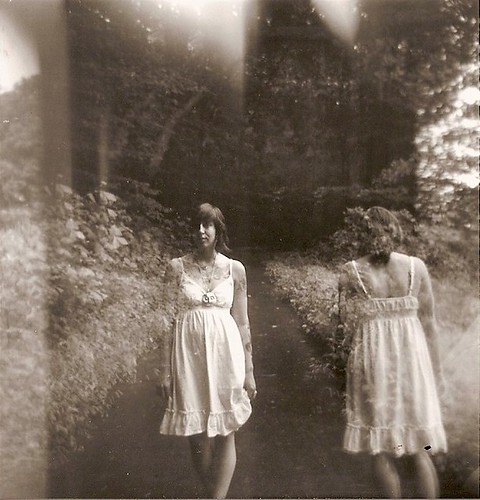
Between An Erupting Earth And An Exploding Sky by Ashley Buress, Used With Permission.

Lo-fi photography is a style of photography generally using poor equipment, such as toy cameras or pinhole cameras, for stylistic effect. It is often considered a reaction to the perceived ease of creating technically perfect photos in the digital age. Generally the emphasis is on using film, rather than digital technology.
–Wikipedia

The LaundromatPop CornSave-A-LotUnleaded $3.239

Recently, I learned an important lesson about photography.  The camera does not make the photograph, the photographer does.  This concept has been intentionally dismissed by camera companies who insist that you need the latest, most high-tech, and expensive camera gear to create beautiful images.  Recently some photographers have become late adopters to the idea that beautiful images can be created with outdated and sub-standard camera gear.  Sadly, with the era of digital photography, film cameras are now slowly being considered lo-fi, as are Polaroid instant print cameras.

Perhaps the most notable lo-fi cameras include Dianas, Holgas, Lomos, and as far as digital is concerned, very low megapixel digital cameras.  The featured image at the very beginning of this article was provided for use by Ashley Buress, whose Flickr photostream (at the time of this writing) was almost completely filled with some very impressive lo-fi photography.  The remainder of the photos in this article were taken by me, using my Blackberry Curve 8530.

Stone PonyOld Man At The CounterNapkins Over The Parking LotThe Old General Store

Despite the artistic appeal of lo-fi photography, it can also have some practical uses.  A lot of folks feel the idea of carrying around a DSLR everywhere you go is a practical idea, however cell phones have become a vital accessory of modern life.  With the advent of camera phones (cellular phones with built-in cameras), the ability to have a camera with you at all times suddenly appeals to quite a lot more people.  As I mentioned earlier, the photos in this article were taken with a camera phone, which at roughly 2 megapixels, it qualifies as a lo-fi camera by todays standards.

It never ceases to amaze me how those with simple low-end cameras always dream of having the latest high-end cameras of their well-to-do counterparts.  And yet, even more amazing are the photographers who own the high-end equipment who look to those with toy cameras for advice on how to make their photographs look as if they were taken with lo-fi equipment.

The good news is that if you are lucky enough to own a modern DSLR, chances are you can step-down the resolution of your final image.  In other words, instead of your camera producing a 10 megapixel image, most modern DSLRs will allow you to set the resolution down to 5 megapixels, 2 megapixels, or further down.  Alternatively, there are a lot of people making a small fortune by selling Photoshop Actions that simulate lo-fi photography.

My photographic passion is grunge photography.  In future posts, I’ll discuss ways of turning high-end digital photographs into photographs that look as if they were taken using lo-fi cameras.

High Contrast Grunge Photography

High Contrast Grunge Photography takes the look of traditional Kodalith darkroom prints to the digital era (or for those of you still shooting with film, and developing in a darkroom, keeps Kodalith alive). By the way, there is a Kodalith group on Flickr!

Old Sneakers

Read More→

The Exploration of Aiden Lair Lodge

During a recent drive through the Adirondacks, I came across this abandoned lodge along route 28N in Minerva, New York. A sad reality exists, especially in the United States that many historical buildings and places are being left to decay, alone in their own abandon. Ideally places like this would be preserved somehow as part of our own American history.

The following photographs document the current state of just one of many such places that despite their historical significance and importance, are being left to rot and decay, forgotten by all but the most curious of people, like me, who stop in for a closer look, before it’s lost and gone forever. Ideally, I’d like to think that my photographic documentation of abandoned places such as this will raise some much needed awareness and possibly lead to some preservation efforts. The photos presented here can also be seen here, on Flickr.

A Little Privacy Please

The Story Of Centralia, Pennsylvania

[Public Domain Image]

Centralia was incorporated as a borough in 1866. The anthracite coal industry was the principal employer in the community. Coal mining continued in Centralia until the 1960s, when most of the companies went out of business. Bootleg mining continued until 1982. Strip and open-pit mining is still active in the area, and there is an underground mine employing about 40 people three miles to the west.

The borough was served by two railroads, the Philadelphia and Reading and the Lehigh Valley, with the Lehigh Valley being the principal carrier. Rail service ended in 1966. The borough operated its own school district with elementary schools and a high school within its precincts. There were also two Catholic parochial schools in the borough. The borough once had seven churches, five hotels, twenty-seven saloons, two theatres, a bank, a post office, and 14 general and grocery stores. During most of the borough’s history, when coal mining activity was being conducted, the town had a population in excess of 2,000 residents. Another 500 to 600 residents lived in areas immediately adjacent to Centralia.

It is not known for certain how the fire that made Centralia essentially uninhabitable was ignited. One theory asserts that in May 1962, the Centralia Borough Council hired five members of the volunteer fire company to clean up the town landfill, located in an abandoned strip-mine pit next to the Odd Fellows Cemetery. This had been done prior to Memorial Day in previous years, when the landfill was in a different location. The firefighters, as they had in the past, set the dump on fire and let it burn for a time. Unlike in previous years, however, the fire was not extinguished correctly.
-Wikipedia

On March 19, 2011, I was finally able to visit Centralia, Pennsylvania. Unfortunately, due to the current state of Centralia, it exists on few maps, and it is a sensitive topic amoung current residents who still live in the area. After doing extensive research on the Internet for quite some time, I had expected to find at least a few standing buildings that would indicate that a town stood here at one time. Unfortunately, when I arrived, I found nothing but crumbling pavement and empty streets. Cracked sidewalks among forgotten plots of land filled in the spaces where buildings once stood. Read More→

The Exploration of Eastern State Penitentiary

ESP (5)

The Eastern State Penitentiary (ESP) is a former American prison in Philadelphia, Pennsylvania. It is located on 2027 Fairmount Avenue between Corinthian Avenue and North 22nd Street in the Fairmount section of Philadelphia and was operational from 1829 until 1971. Its revolutionary system of incarceration was the first to establish the policy of separate confinement, emphasizing principles of reform rather than punishment. Notorious criminals such as bank robber Willie Sutton and Al Capone were held inside its unique wagon wheel design. When the building was erected it was the largest and most expensive public structure ever constructed, quickly becoming a model for more than 300 prisons worldwide. –Wikipedia

On May 28, 2010, myself and a group of friends decided to check out Eastern State Penitentiary in Philadelphia, Pennsylvania.  At the time, I was following up on a tip from a fan of my website (while I’m on the topic, I’m always looking for tips).  Opened in 1829, the prison housed some of America’s most notorious and dangerous criminals, such as Al Capone and many others, up until its closing and subsequent abandonment in 1971.  Today, it is a crumbling structure of guard towers and cell blocks which are kept in a perminant, yet stable state of disrepair and abandonment.  The prison is a fantastic sight to behold and a perfect location for grunge photography. Read More→

50 Stunning Examples of Abandonment

Hogback Ski Area (3)Abandoned Fire Extinguisher In The WoodsUnderground FloodAbandoned Farmhouse, Burned (10)Abandoned Mini Roller CoasterAbandoned SupermarketExcevator (2)Abandoned BridgeAbandoned Roadside Farm #2Empty House 1 - 15Abandoned Barn With Rusted RoofAbandoned DamAbandoned House Swallowed By Overgrowth (2 of 2)ForgottenAbandoned Bucket (4)Abandoned Chicken FarmDestroyed BoxAbandoned RetreatCabin Along Route 20UntitledAbandoned Farm Vehicles 3Abandoned Industrial Washing Machine In WinterForgottenAbandoned Ford Truck (2)The Working Man (1)The Life They Let Slip Away (Holga Edit)Abandoned ShackAbandoned HouseAbandoned ChurchAbandoned Sunoco Gas Station (1)Abandoned Gas Station Along NY-147 (3)Dead LocomotiveAbandoned Industrial Mine (1)ESP (17)Abandoned Barn With Tin Roof (2)Horse Barn (2)Rockland Drive-In (1)Red Apple Rest (11)Goodwill Poultry Farm (12)Two Train CarsHogback Ski Area (2)Abandoned Train Depot - Full ViewDestroyed OfficeNo Radar - Grunge EditDead Red TruckEmpty House 1 - 1Dead Car (1 of 6)Abandoned Rail Yard (9)Baby StrollerAbandoned Hydro Plant 6

These 50 stunning examples of abandonenment are from my Flickr photostream.  I feel like they represent some of the best examples of my grunge photography and urban exploration photographs.