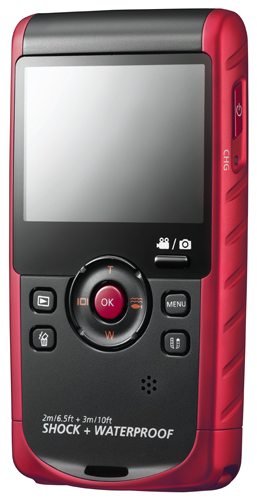
 April 22, 2011 – PRESS SUMMARY – Samsung Electronics Co., Ltd, announced the launch of its W200 Pocket Cam. The W200 is designed so it can be taken anywhere to capture brilliant video in the toughest conditions, particularly underwater, thanks to features such as a 5 megapixel BSI CMOS sensor and F2.2 Bright Lens. Created for those whose active lifestyles demand both durability and quality, it houses Samsung’s leading imaging technology in a shock, water and dust-proof rugged body.
The W200 is built to withstand the elements to produce high-quality video in almost any circumstance and thanks to specialized functions, it makes brilliant underwater video easier to achieve than ever. It is waterproof up to three meters, making it suitable for great video of a relaxed day by the pool or even up-close shots of coral reefs. The W200’s anti-water drop coating also means that the LCD screen will stay free of condensation, even in damp conditions, so you can film without wiping the screen. The lens also features anti-fog coating that lets steam disperse so you always have clear, blur-free videos and pictures even straight after coming out of the pool. To make capturing amazing underwater footage simple, the W200 also includes an Aqua Mode setting, which automatically sets the ideal parameters for the bright and clear underwater video. Despite being slim and compact, it is also shock-proof and dust-proof and so is the perfect addition to a backpack for any trip and robust enough for worry-free family vacations with young children. Because the W200 is designed to be taken anywhere, it also comes with a built-in USB arm to make it easy to share your adventure. Read More→

Founder of Current Photographer, co-host of The Digital Photography Cafe Show, Designer, Photographer, and overall tech geek.

 Jan 10, 2011 – PRESS SUMMARY – Canon U.S.A., Inc, announced the new ultra compact XA10 Professional Camcorder, ideal for situations where mobility while shooting is critical. This feature-rich, professional model records Full HD 1080p video using an AVCHD codec. The ultimate professional camcorder for run-and-gun shooting, the compact XA10 includes a detachable handle for low-angle shooting and portability. With the handle attached, the XA10’s functionality is further enhanced with the addition of XLR inputs and an external microphone holder. Capable of shooting in the dark, the camcorder features infrared video capture, ideal for Military and Law Enforcement markets, as well as Nature and Wildlife videographers. The new XA10 provides the option of recording to a 64GB internal flash drive or two SDXC-compatible card slots, as well as Relay Recording and the ability to record simultaneously to two cards for instant backup. Extremely portable yet packed with professional features, this camcorder will be the model-of-choice for on-the-go videographers shooting online news, celebrity reporting, reality TV, extreme sports, etc.

 Jan 8, 2011 – PRESS SUMMARY – JVC announced the world’s first consumer camcorder to offer 3D recording in Full HD, thanks to a new JVC-developed high-speed processor that can produce two simultaneous Full HD images.


 Sept 6, 2010 – Panasonic has a new consumer camcorder coming out in October that shoots 1080p HD video in 3D. The camcorder uses a 3D conversion lens attached to their 700 series 3MOS system. The 3D video is shot using the same principle as human vision. Left and right eye images are simultaneously shot with two lenses and the 3D images artificially create visual disparity. The brain uses visual disparity to perceive spatial depth and the appearance of solidity. This visual disparity is artificially produced for 3D images so that the brain will interpret it as depth and solid-appearing objects.
