Archive for Lighting Tips

Photography 101: Lighting Alternatives

When one thinks of lighting and photography, the idea of flashes and strobes probably come racing to mind right away. This maybe true for a vast number of photographers, however there are plenty of other ways to get your lighting on, and they will not even break the bank. Some solutions may even surprise you!

Let’s get the easiest lighting source out of the way right now. That solution is natural lighting, or the sun. The sun never runs out of batteries, won’t blow up in the middle of a shoot, and is not something you will need to worry about getting stolen while you are out doing your work. On the downside, you cannot control the sun, and it may not cooperate with you. There is also having to work around those peak times of shooting in the morning and in the evening. Even with its uncontrollable nature, the burning star in the sky is easily the most reliable light you can use.

So what do you do when the sun is blanketed in clouds. Have no fear, as cloudy weather can provide a big benefit to your lighting needs as well. Overcast skies often reduce harsh shadows. This means if you are shooting flowers, bugs, and whatnot, the need for fill light may not be necessary. Clouds also provide a more interesting sky. Learn to work with Mother Nature as she provides some of the best options around! Read More→

The Water Logged Alien Bee Zombie Lights: by Ryan Armbrust

A few days ago, I set off to snap a senior portrait session at a football field. The guy I was shooting is a football player, so it seemed like a fantastic idea. We had keys and permission to use the field. I packed up my trusty Alien Bee 800’s as well as a battery pack to power them, some grids and the rest of my camera gear and headed to the field. When we arrived, I quickly found the shot I wanted. I would place him in front of the score board right at sunset. I set my lights up and popped off a couple test shots. I wanted to get everything in place so I would not be rushed at sunset. I wanted that nice cobalt blue sky that last about 10 minutes. After everything was set up, we headed to the other end zone to grab some natural light shots.

AS SOON AS WE GOT TO THE OTHER END OF THE FIELD, THE SPRINKLERS CAME ON!

Read More→

How To Alter Colors During a Photo Shoot: by Guy Van Hooveld

My experience with corporate shoots is that sometimes, the environment is not exactly like the customer has described it, or does not really provides the kind of colors or light allowing to deliver the message you need. That is the reason why I use equipment to modify the look of a specific scene during the photo shoot. Some coloring is of course always possible in post production, but I am not a Photoshop freak, and I prefer to get the results right the first time, and to minimize post production.

First Example

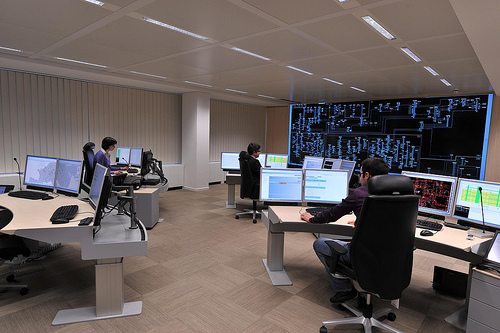
This example was a shooting session in a control center. A few pictures were expected for a press file, showing the “hi-tech” look of the dispatching center. When I arrived on location, I was impressed by the “clean” aspect of the room, a bit like a hospital. I decided to use color filters on strobes to give a more dramatic aspect to the pictures. After some tests I decided to go for dark blue, to give a “night” impression.

Let’s just follow the different steps:

Just for information, the used equipment was:

  • Nikon D3 camera with 24-70 2.8 lens on a tripod with hydrostatic head
  • Radio controlled shutter
  • Radio controlled strobes
  • 600Ws Strobes with color filter and barn doors, with digital energy selection
  • Lightmeter to determine exposure

A first picture to show the environment as it was

Read More→

How to Use Your Flash Outdoors for Some Interesting Effects: by Guy Van Hooveld

This might sound strange but it is possible to get interesting effects with a flash on a very sunny day. The classical application is to use fill flash to get the proper exposure in the shadows, but there are other possibilities as well.

I decided to experiment with cheap gear, so that anyone could give it a try: I am still using my simple Nikon D40x on a regular basis to have some fun… I added a flash (a simple Nikon SB-600, but any other similar or better flash will do, like the SB-800 or the more recent SB-900) I also (re)discovered the use of an iTTL flash cable conecting the flash to camera body hotshoe to flash from various angles with cameras without the wireless possibilities of CLS (and without the delay introduced by CLS, the wireless Creative Lighting System by Nikon)

Here are a few examples in the sun, using the 60mm AF-S micro lens, diaphragm closed down to f13-16, with a touch of flash.

Flowers Flash Above

Flash from above just to show the flowers.

Read More→

Speedlite Built-in Snoot

How many of us professionals forget that our strobes have a “ZOOM” feature? Zoom is normally set too automatic and will focus the strobe beam of light based on the lens “Zoom” setting.

Example: If we’re using a 24-70 lens and have it zoomed out to 24mm your flash would automatically fire a beam of light broad enough to encompass the entire frame. Now if we take the same picture and zoom in with lens to 70mm our strobe will focus that same beam of light to only strike the area which is now framed within the camera. This process saves flash power and overall works great! Read More→

Portable LED Lights for Under $20 – by Scott Wyden

Don’t be afraid to experiment! Don’t be afraid to try something new! Even if you can’t afford the expensive lighting and gear you can still have a blast playing with light. Go to Home Depot and pick up some Sylvania DOT-it lights. They even come in multi packs. For under $20 you can have portable LED lights that can really bring some great light to a photo.

Sylvania DOT-it Lights

Read More→