Archive for Shooting

Panning For Creativity – Behind My Eyes

Every photographer I’ve met has gone through what is generally referred to as ‘creative block’ – we struggle to see creatively when out with the camera. If you ask ten photographers how they get out of a creative block, you’ll likely get 10 different answers, or close to it, because there is no one correct answer – what works for one person may not for another. Personally, I use a couple of methods to try and snap out of the block and one of them is panning.

In simple terms, panning is following a moving subject with the camera. At higher shutter speeds, this technique can freeze action, a method used by sports photographers covering events, like football games, cycling and auto racing. At lower shutter speeds, panning can give a sense of motion to a frame, which is the method I prefer. This can also be used in sporting events, but when the creative juices need help, I like to use it for street photography, like the image below.
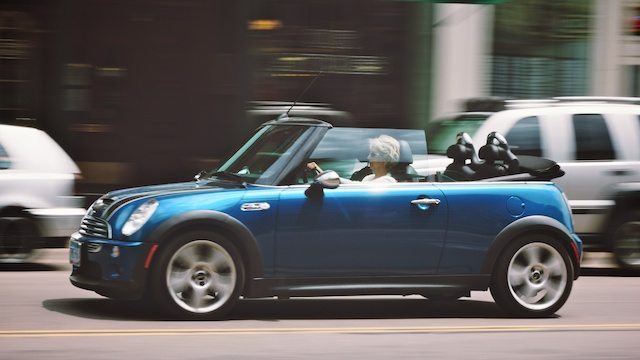
Cooper Mini – f18, 1/40s

Presenting a sense of movement in a photo can really add life to it and that goes very well with street photography. Take the image above. Just standing there watching this Cooper Mini drive by is pretty much a ho hum deal, but blur all of the objects around it and give the wheels some movement and you turn this lady into the one from Pasadena that Jan and Dean used to sing about! Now that’s dating myself! Here’s how I go about taking panning shots. Read More→
Down Low – Behind My Eyes

One of the best pieces of advise I can give to someone who’s trying to improve their skills as a photographer is to get involved in social networking and start looking at other people’s work. First of all, the social part of it can be very rewarding, meeting and getting to know the really great folks in this industry and being able to get your work out there in front of other people. But the real benefit in looking at other great photographers’ work (and not so great ones, too) is that you can learn what aspects of an image you really like or dislike and apply them to your own product.

When I first started taking pictures, my images would look like nearly every other new photographer. We plant the tripod up fully extended, compose the frame and take the shot. This didn’t change for long time, until I saw an image from my friend Brian Matiash that really had an impact on how I would take pictures in the future.

2012 (c) Brian Matiash – All Right Reserved www.brianmatiash.com

Read More→

Scenic Outlook – Impressions

We all love to go out and get those pin sharp, beautifully lit shots of our countrysides and cities, but for today’s post we are going to ignore all of what we have learned about how to make great landscape photographs and look at another way of shooting…Impressionistic photography.

By no means a new idea, it has come and gone over the past few years falling in and out of favour as trends change. However, I do believe that used thoughtfully, impressionistic photography has as much of a place as any other type of photographic style. Impressionistic photography is not about producing a big splash of colour on the page, the picture at some level must relate to what is being photographed. The aim is to create a more painterly effect, perhaps with the intention of evoking a dreamier mood, or to show movement of a particular subject. Read More→

Dealing With Less Than Cooperative Wedding Guests

Ah yes, the age old problem. Open Bar + Close Proximity To Others + Party = the Less Than Cooperative Guest. It’s something that we’ve all had to deal with and if you haven’t yet as a wedding photographer, you will. There is always the one guest that has had a little too much to drink and either offers an abundance of unsolicited advice or proceeds to just make your night rough. As a professional you should remember that you are there at the request of the wedding couple and most importantly, you have a job to do. This is business, nothing personal.

I’ve had this happen to me unfortunately on a couple of occasions. I’ve had the “friend” who is a photographer come up to me and try to “one-up” me on everything from equipment, to style, to poses for photographs. I’ve also had the gentleman who’s had one too many proceed to try and get in every single photo I took whether he was supposed to be in the shot or not. These kinds of things are going to happen and these aren’t the kind of things your photography class instructor probably went over very much when you took their crash course. The most important thing to remember is to maintain your composure. Most of the time they don’t have a clue who you are and are just talking to someone who will listen. I make it a point to try and be as professional and courteous as possible and let them know that unfortunately I don’t have a lot of time to chit chat right now that the bride and groom are on the move. You will learn what works best for you the first few times you use it.

As for the wedding guest who insists on trying to get in every shot that I am taking whether invited or not, that is going to take a little more tact and a little more “air of authority” in your voice. I make it a point to lower the camera and with a smile on my face, politely ask the guest to please step aside for just a few seconds while I gather this shot. Most of the time they will comply. If in the event they do not, you have a few options but one that I would probably employ is simply to ask the guest you are trying to focus on to simply change their location so as you might get their shot without interruption. I’m sure they will be more than accommodating.

Read More→

The Art of Being Inconspicuous

Weddings are very expensive, very personal, very intimate events to be shared by the wedding couple and their closest friends and family. It’s a time when two people promise before the world their love for one another and their commitment to each other till death do them part. It’s truly a once in a lifetime event. Never again will these two people stand together at this moment, in front of these people, saying these words to one another. The last thing they want is some goofy photographer running around getting in the way and causing a distraction! It’s our job as professionals to not become part of the event but to simply capture the event for the couple and their family to enjoy for generations to enjoy.

I know it’s hard to stay inconspicuous while at the same time capturing once in a lifetime moments but it can be done. I am a 6’ 2” 300lb beast of a man and I can blend in with the best of them. The trick is being aware of your surroundings. Plan out your shots.  Be familiar with the schedule of the event so you know when and where to be for all the right moments. There is no reason to be running up and down the aisle if it’s not necessary. Many ministers don’t appreciate it and most of all your clients and their guests will not appreciate the distraction. Here are some tips I employ to practice what I call non-invasive wedding photography.

Invest in a quality long lens. Somewhere in the 70-300mm area and make sure it has IS (image stabilization). These lenses take great photos, are wonderful at getting close-ups of the ring exchange and first kiss as well as capturing those intimate fleeting moments between the bride and groom all the while letting you remain behind the wedding guests but still able to capture wonderful images. Long lenses allow you to be where you need to be without you being in the way. Ever heard the expression “you make a better door than you do a window”? Guests will appreciate it that you are not distracting them from an event. I attended an event one time where the photographer had an assistant who was holding 2 slave flashes and he had the master on his DSLR. He was running (literally running) up and down the aisles to capture that shot. When the bride and groom were leaving back down the aisle he had all flashes going off in front of them as he and the assistant walked backwards down the aisle not 8 feet from the bride and groom. It was distracting, I was distracted. I don’t remember much about that wedding but I remember a lot about that photographer and that is not the kind of memory we want to be remembered for. Read More→

Think More, Shoot Less: by William Petruzzo

I think that photography as an art has taken a pretty big hit since the widespread acceptance of digital cameras. Hipstematic takes an arbitrary picture of a coffee cup taken with an iPhone and turns it into “art”. Bigger memory cards mean there is less and less risk in pressing that shutter button. Like never before, “art” in photography is largely an accident. But is it art at all? I think not.

I define art, not by what is produced, but by what the artist’s mind was doing when it was produced. By that definition, art must be intentional. You cannot simply fire off 10,000 pictures to find those 2 works of “art”. What you found wouldn’t be art at all, it would be a series interesting coincidences. Think about it this way—imagine that you could record everything your eye sees in brilliant high definition and at any point, pull out a single frame and publish it to Flickr. You probably wouldn’t consider that art. Yet this is often what digital photographers do. They point their camera in a thousand directions and find a few images that are interesting enough to share. Anyone can do that.

So, as digital photographers, how do we find our status as an artist? I submit that we find that status by learning to be intentional; by making calculated decisions about the things we photograph; by refusing to press the shutter down before we’re sure that what we’re about it capture is what we intend to capture.

Now, before I move on, let me interject briefly. Photography has a great history of accidentally capturing incredible moments. In fact, some of history’s iconic photos were total accidents.  And that’s okay. Because at that time in history, skilled photographers routinely and intentionally captured beautiful images. And sometimes, they caught beautiful accidents. But it was the exception, not the rule. And that’s part of what made those photos so remarkable. Today, it’s often the other way around. So, while there is a place for incredible coincidences in photography, as photographers we should once again aim to make them the exception, not the rule.

So, in the interest of learning to become true artists, here are six techniques to stretch our intentionality in the creation of our images and heighten the artistic integrity of our work. It’s all about thinking more, and shooting less. Read More→