Archive for Tips

Three Reasons You’re Not Ready To Shoot A Wedding – And One Way To Fix It: by Angelo Stavrow

boutonniere

Photo Credit: © Angelo Stavrow, Saad Khan and Caitlyn Bom

With the advent of low-cost digital SLRs, the field of photography is being democratized — even the most entry-level version sports image quality and responsiveness that stand head and shoulders above the point-and-shoot cameras that reign supreme in the consumer market, offering the first-time photographer an excellent tool with which to begin learning.

Inevitably, newbies flood photography forums on the Internet, wearing their heart on their sleeve and putting their best work up for critique.  A curious sequence of events then unfold for our newbie: She puts up a few colourful sunsets, maybe a few flowers, a couple of black-and-white portraits; since she love taking photos, her SLR is always with her. She gets to be know as The Gal With The Awesome Camera.  And then, almost out of nowhere, it happens: some friend or acquaintance, having seen her photography, asks her if she’d be interested in shooting their wedding.

This was exactly my situation a few years ago.  A friend of the family, looking for an inexpensive wedding photographer, asked if I’d be willing to take on the job.  They couldn’t offer me much money, but that didn’t matter — I refused the job, because I honestly didn’t feel that I was ready and able to do it.

Little did I know how right I was.

As a relatively-new photographer myself (at least when it comes to shooting professionally, and especially at weddings), I often see the old guard either a) warning new entrants of the pitfalls and perils of weddings, or b) actively discouraging these newcomers from giving it a go.  I don’t much care for the latter behaviour, but I’d like to offer some “newbie-to-newbie“ advice to those who would like to try their hand at the wedding game.

I shot my first wedding in the spring of this year, and even though it’s been years since I was last asked to shoot one, I still wasn’t as prepared as I thought I was.  So, based on that experience, here’s why you’re not ready to shoot a wedding.

1. You Don’t Have Enough Gear

For an amateur, I consider myself well equipped.  I showed up the day of the wedding with my Canon 5D Mark II, a couple of lenses, a couple of flashes, and extra batteries, and thought I’d be fine.  And, for a few hours, I was.  I was snapping away happily, until my go-to lens –a Canon 24-70mm f/2.8L– started throwing sporadic “ERR00” communication errors.

the_happy_couple

Photo Credit: © Angelo Stavrow, Saad Khan and Caitlyn Bom

Great.  So I could either just grin and bear it, fussing with the lens every time it went awry, or put it away for the rest of the night, and deal with switching between primes (I had a 28mm, a 50mm, and an 85mm with me as well).  Both situations meant wasting time, and, worse, potentially missing The Shot.  If I had a second body, I’d have just put away the 24-70 and slapped a prime on each — probably the 50 and the 85 — and been fine.

Then there were the issues with the flashes.  Well, technically, the flashes worked fine, but trying to trigger them reliably via an ST-E2 transmitter when you’ve only got minutes to set up, pose, and tear down was an exercise in frustration.  Proper radio triggers would have had made this far easier.

Despite these problems, I somehow made it through the night without tossing my gear in the trash bin (or hitting the open bar).  I definitely have a much better idea now of what I should have brought, what I didn’t need to bring, and how to work gracefully around the problems that invariably crop up with gear.

2. You Don’t Have Enough Time

I spent about ten hours shooting the wedding and came back with nearly 700 photos.  That’s actually not many, by professional standards — maybe half of what could be expected.  And, hey, I’ve come back from vacations with just as many –if not more– photos, so it’s not like I’ve never had to deal with that many images at once before.

Except for one thing.  Wedding photos have to be delivered to the client within a reasonable amount of time. My vacation photos?  Yeah.  I’m a couple of years behind.

Like many of us, I have a full-time job, and other obligations besides photography.  Frankly, finding the free time to go through and process these photos for the newlywed couple within a few weeks was simply not going to happen, unless I decided to forego things like, well, sleep.  The day of the wedding is only a portion of the entire time you spend on these jobs — you’d better have an efficient workflow to get it done in a reasonable period of time.

3. You Don’t Have Enough Experience

I’ve shot concerts and art show openings (as an amateur) and figured that a wedding wouldn’t be much different.  I mean, heck… it’s basically just event photography, right?

Wrong.  So very, very, wrong.

None of these events will adequately prepare you for the ten to twelve hours you spend on your feet, coupled with barely having time to inhale a granola bar, dealing with friends and family of the newlyweds ruining your shots to get their own photos, guests taking advantage of the open bar (luckily, that wasn’t an issue for my first experience), and trying to get wedding portraits in the middle of one of Ottawa’s most popular museums (where the reception was held) before closing hours.

The Fix: Mentorship

backlit_kiss

Photo Credit: © Angelo Stavrow, Saad Khan and Caitlyn Bom

So, how did I manage to not make a complete arse of myself?

I was offered a great opportunity by a pair of wedding photographers, Caitlyn Bom and Saad Khan: Tag along on a large wedding that they were going to be shooting, as an apprentice.  I wouldn’t be paid, but I’d be there as a third shooter.  They’d seen my work, and felt confident enough about my professionalism, and thus invited me to join them.  It was a win-win situation: I would get to try out wedding photography without the performance anxiety, and they’d get additional coverage of a large event.

So what if I didn’t have enough gear?  If my stuff failed, there were still two other photographers there, with their own equipment, to cover the event.

So what if I didn’t have the time to process all the photos I shot?  They took full control of the deliverables, so all I had to do was provide the images — they’re the pros and thus have their workflow down.

So what if I had no experience?  I had theirs to draw upon.  I learned a lot from the event, sure, but the most valuable lessons came from watching professionals in action: dealing with the clients, dealing with the guests, dealing with the venue management, and dealing with each other.

So, you may not be ready to shoot weddings — but there is a fix.  Talk to pros.  Seek out mentors.  You can learn plenty from a photography website, but nothing beats learning-by-doing.

Many thanks to Saad Khan (Toronto) and Caitlyn Bom (Syracuse, http://caitlynbom.com) for the opportunity to learn.


Update: This article has been very popular and made it’s way into many Facebook posts and forums. There’s a Flickr discussion going on here that’s worth checking out.


Angelo Stavrow HeadshotAngelo Stavrow is a freelance photographer and writer in Montreal, Canada, who takes photos because he’s rubbish with paintbrush and a canvas.  He prefers to enjoy the big picture, rather than examine the individual pixels.

Website: http://angelostavrow.com
Twitter: @angelostavrow

Photo Credit: © 2010 Angelo Stavrow

Here’s how you can share your tips, techniques and tutorials on CurrentPhotographer.com

–  RH7Z7B5VTVRR
Panning For Creativity – Behind My Eyes

Every photographer I’ve met has gone through what is generally referred to as ‘creative block’ – we struggle to see creatively when out with the camera. If you ask ten photographers how they get out of a creative block, you’ll likely get 10 different answers, or close to it, because there is no one correct answer – what works for one person may not for another. Personally, I use a couple of methods to try and snap out of the block and one of them is panning.

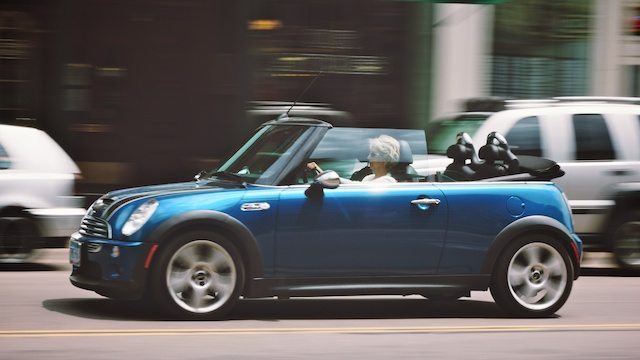
In simple terms, panning is following a moving subject with the camera. At higher shutter speeds, this technique can freeze action, a method used by sports photographers covering events, like football games, cycling and auto racing. At lower shutter speeds, panning can give a sense of motion to a frame, which is the method I prefer. This can also be used in sporting events, but when the creative juices need help, I like to use it for street photography, like the image below.

Cooper Mini – f18, 1/40s

Presenting a sense of movement in a photo can really add life to it and that goes very well with street photography. Take the image above. Just standing there watching this Cooper Mini drive by is pretty much a ho hum deal, but blur all of the objects around it and give the wheels some movement and you turn this lady into the one from Pasadena that Jan and Dean used to sing about! Now that’s dating myself! Here’s how I go about taking panning shots. Read More→

Scenic Outlook – Preparing for Winter

It doesn’t seem like that long since I did my autumn post but here we are getting into December and the winter months. For a lot of people winter means cold and wet and staying at home all snug and cosy with the fire roaring. Ignore your desire for comfort because if you do you’ll be missing a wealth of opportunity that awaits in the great outdoors.

There are many things that you can get your teeth into during the winter months, with the sunlight remaining fairly low throughout the day you can really make the most of your time. Most of the trees will be bare, which in some cases is when they can look at their best, photographically speaking, especially when there has been a heavy frost or some snowfall as this will really pick out those branches. You could have rolling hills covered in snow, an icy lake, the list goes on and on. Read More→

Dealing With Less Than Cooperative Wedding Guests

Ah yes, the age old problem. Open Bar + Close Proximity To Others + Party = the Less Than Cooperative Guest. It’s something that we’ve all had to deal with and if you haven’t yet as a wedding photographer, you will. There is always the one guest that has had a little too much to drink and either offers an abundance of unsolicited advice or proceeds to just make your night rough. As a professional you should remember that you are there at the request of the wedding couple and most importantly, you have a job to do. This is business, nothing personal.

I’ve had this happen to me unfortunately on a couple of occasions. I’ve had the “friend” who is a photographer come up to me and try to “one-up” me on everything from equipment, to style, to poses for photographs. I’ve also had the gentleman who’s had one too many proceed to try and get in every single photo I took whether he was supposed to be in the shot or not. These kinds of things are going to happen and these aren’t the kind of things your photography class instructor probably went over very much when you took their crash course. The most important thing to remember is to maintain your composure. Most of the time they don’t have a clue who you are and are just talking to someone who will listen. I make it a point to try and be as professional and courteous as possible and let them know that unfortunately I don’t have a lot of time to chit chat right now that the bride and groom are on the move. You will learn what works best for you the first few times you use it.

As for the wedding guest who insists on trying to get in every shot that I am taking whether invited or not, that is going to take a little more tact and a little more “air of authority” in your voice. I make it a point to lower the camera and with a smile on my face, politely ask the guest to please step aside for just a few seconds while I gather this shot. Most of the time they will comply. If in the event they do not, you have a few options but one that I would probably employ is simply to ask the guest you are trying to focus on to simply change their location so as you might get their shot without interruption. I’m sure they will be more than accommodating.

Read More→

The Art of Being Inconspicuous

Weddings are very expensive, very personal, very intimate events to be shared by the wedding couple and their closest friends and family. It’s a time when two people promise before the world their love for one another and their commitment to each other till death do them part. It’s truly a once in a lifetime event. Never again will these two people stand together at this moment, in front of these people, saying these words to one another. The last thing they want is some goofy photographer running around getting in the way and causing a distraction! It’s our job as professionals to not become part of the event but to simply capture the event for the couple and their family to enjoy for generations to enjoy.

I know it’s hard to stay inconspicuous while at the same time capturing once in a lifetime moments but it can be done. I am a 6’ 2” 300lb beast of a man and I can blend in with the best of them. The trick is being aware of your surroundings. Plan out your shots.  Be familiar with the schedule of the event so you know when and where to be for all the right moments. There is no reason to be running up and down the aisle if it’s not necessary. Many ministers don’t appreciate it and most of all your clients and their guests will not appreciate the distraction. Here are some tips I employ to practice what I call non-invasive wedding photography.

Invest in a quality long lens. Somewhere in the 70-300mm area and make sure it has IS (image stabilization). These lenses take great photos, are wonderful at getting close-ups of the ring exchange and first kiss as well as capturing those intimate fleeting moments between the bride and groom all the while letting you remain behind the wedding guests but still able to capture wonderful images. Long lenses allow you to be where you need to be without you being in the way. Ever heard the expression “you make a better door than you do a window”? Guests will appreciate it that you are not distracting them from an event. I attended an event one time where the photographer had an assistant who was holding 2 slave flashes and he had the master on his DSLR. He was running (literally running) up and down the aisles to capture that shot. When the bride and groom were leaving back down the aisle he had all flashes going off in front of them as he and the assistant walked backwards down the aisle not 8 feet from the bride and groom. It was distracting, I was distracted. I don’t remember much about that wedding but I remember a lot about that photographer and that is not the kind of memory we want to be remembered for. Read More→

Shooting A Wedding Is Like Shooting On The Move

Shooting a wedding is like shooting while you are walking. As a wedding photographer, you are constantly moving, your lighting is constantly changing, your models are not professionals and getting their attention is next to impossible. So with all these obstacles, how do you go about getting those one-of-a-kind beautiful wedding photos? Well in short, you do it quickly.

As a wedding photographer your skills as a professional are never in more need than they are during a wedding. A wedding is a moving photoshoot. From the time that the bride and groom walk down the aisle to the time they are together on the altar the lighting is different. You as a photographer have to be able to adjust for this. You have to know that in the 30 minutes or so after the wedding you have to put together 10 to 30 small portrait sessions when you do the formal portraits of the wedding party. You have to anticipate what your lighting is going to be like when you get to the reception. You have to be ready for anything.

Your first priority is planning. If you have never been to the ceremony location and it is located in the same city you are in I suggest you make a visit prior to the event date. Check the lighting; check out the surroundings and the backgrounds. Scout for the best location to take the formal portraits after the ceremony. Talk with the location event coordinator if possible and ask about rules for photographers during the event. Every location has their own rules and they are all different. If you want to be respected and asked to return I advise that you follow those rules to the best of your ability. I also suggest that you make your client aware of any rules that may impair their perception of how the wedding photography should happen. Read More→