Author Archive for Dave Wares

Scenic Outlook – Embrace Manual Mode

Modern cameras are truly wonderful devices, every time a new one comes out it’s seems to be packed with more and more cool stuff to temp you into parting with your cash. Of course many of these features can be quite useful in certain situations but for the most part a good proportion of functions will rarely be used. This is very true for the landscape photographer. Sturdy build, good glass, a decent viewfinder, a reliable light meter and the ability to alter the aperture and shutter speed separately is all it needs to do. The question of resolution/pixel count really comes down to what it is that you’re going to be doing with your images, and if you never print larger than A4, a 6MP DSLR will do the job just fine. 12MP seems to be a good amount for the majority of folks but even the lower end cameras are now offering more resolution than this; cool if you want huge prints or to aggressively crop your images, but most of us just won’t utilize the full resolution of our cameras.

So, your camera will come with a number of exposure modes; Program, Shutter priority, aperture priority, Auto, Manual and in addition to this there will be a selection of scene modes to choose from. I only ever use two of these modes; Aperture priority and Manual. Aperture priority is great in situations where you have to work fast; you get to choose the aperture and thus the depth of field, and the camera selects an appropriate shutter speed to get a good exposure, or at least what it deems to be a good exposure.

Read More→

Scenic Outlook – A Word on Lenses

I was having a thought to myself the other day about the types of lenses, or more specifically, the focal length of lenses that every Landscape photographer would think about having in their bag. So I’m going to briefly run through the things you might want to consider when packing your gear for a particular location. Also, this is not going to be about zooms vs primes, merely focal lengths and their effect on a scene.

Most people would think that the 18-50mm or 28-70mm (35mm equiv) would be a pretty safe bet to cover most situations, and they’d be right; in fact most of the pictures I take are within these focal ranges, so I would recommend that you keep something similar in your bag at all times.  Most people would also say that a super-wide angle lens in the range of 10-24mm would also be a good accessory to have in their bag. These are great when you want to go that extra mile to either a). Get more elements into the shot, or b). Exaggerate the perspective. When working with very wide angle lenses it is important to make sure that all the elements you are seeing with your eye are not lost when you’re looking through the view finder. Because the angle of view is much wider, the elements in the scene become much smaller, so make sure that the lovely rocky outcrop in the distance doesn’t become a bunch of pebbles you can barely see at all. When using these lenses be sure to compose your images with strong elements that lead the viewer  from the foreground to the middle and on into the distance.

(18mm Crop sensor)

Read More→

Scenic Outlook – Impressions

We all love to go out and get those pin sharp, beautifully lit shots of our countrysides and cities, but for today’s post we are going to ignore all of what we have learned about how to make great landscape photographs and look at another way of shooting…Impressionistic photography.

By no means a new idea, it has come and gone over the past few years falling in and out of favour as trends change. However, I do believe that used thoughtfully, impressionistic photography has as much of a place as any other type of photographic style. Impressionistic photography is not about producing a big splash of colour on the page, the picture at some level must relate to what is being photographed. The aim is to create a more painterly effect, perhaps with the intention of evoking a dreamier mood, or to show movement of a particular subject. Read More→

Scenic Outlook – Monochrome

Landscape photography in colour is a truly beautiful thing, the pink and purple hues of dawn, a red sunset or a blue sky above a golden sandy beach, colour can really make an image pop. However, sometimes colour can become a bit of a distraction or perhaps it may be that there isn’t enough colour in the scene to make it exciting for the viewer. For example, red is a very strong colour and say you’re taking a shot of a nice blue car but there is a person in the background wearing a red coat, your eye is naturally drawn to the red coat thus taking away from the car of which you were trying to make the main feature.

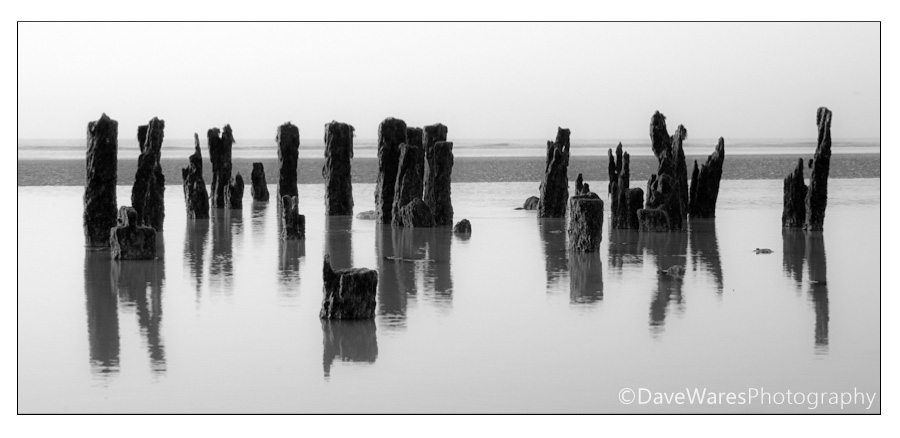
Not every scene will benefit from being presented in monochrome and in a lot of cases a picture can become too cluttered with the viewer not being a clear indication of where to look. So it’s time to train your brain into seeing in black and white even though we see in colour. The key to achieving a more successful mono image is to simply view the scene in terms of shape and contrast. It’s the same compositional idea that drives all photography and knowledge of basic composition ideas will give you a big head start. Look for bold objects such as a large boulder in the countryside or a fence that you can use to lead the viewer through the scene, or look for things that are in contrast to their surroundings. Lets take the image above as an example; the wood posts are virtually in silhouette against the overcast sky and bright water, so by placing the camera where I could see them arranged in a line I produced a simple yet striking composition, and with the sky being mostly overcast there was very little in terms of colour so the obvious thing was to remove it. Read More→

Scenic Outlook – Brief Moments

What with one thing and another I’ve not had as much time over recent weeks to get out with the camera, but on this particular December weekend I have an empty slot on a Sunday morning. Friday’s weather report says that Saturday will be rainy all day but that Sunday will be cloudy with sunny intervals. Right then, decision made my cousin Steve and I make arrangements Friday afternoon to meet up early Sunday morning at Winchelsea beach. Saturday comes and goes with not a drop of rain all day, I look at the weather report on my HTC…Sunday=rain. Oh well, I decide that I’ll go out anyway however the weather should turn out. I text Steve to see if he’s still up for a meet and a moment later he replies to say that he too is up for getting out whatever the weather. Sunrise is about 7.40am so I decide to set my alarm for 6am.

5.35am my phone rings. ” Are you up Dave” says an all too alert sounding Steve. “I am now” I reply, trying to open my eyes. “I woke up early so I got up and now I’m about to head out the door” Steve said, “OK, I’ll meet you there” I say, fumbling about trying to find my things. Right, I’d better get a move on.

6 seconds iso200 @f22, ND4 filter, Grey Grad

Read More→

Scenic Outlook – The Early Bird

It’s 4:30am and my alarm clock has just gone off, it’s still dark out but as I look out of the window I can see both cloud and starlight. This could potentially be a good morning for photography. I had already planned for a trip out today so everything was already packed up and ready to go. All I had to do was drag myself out of bed, throw on some clothes, grab my gear, get in the car and go.

For today’s shoot I had planned to go to Bodiam Castle, not a half hours drive from my house I knew that I could get there well before sunrise. When I arrived it was still pitch black and the gates to the car park were closed. No worries, I just parked in front of the gates. I would be at home with coffee and breakfast by the time staff arrived to open up. With my hat and gloves on, I grabbed my gear and set off up the path towards the castle.

Read More→