Archive for creativity

Panning For Creativity – Behind My Eyes

Every photographer I’ve met has gone through what is generally referred to as ‘creative block’ – we struggle to see creatively when out with the camera. If you ask ten photographers how they get out of a creative block, you’ll likely get 10 different answers, or close to it, because there is no one correct answer – what works for one person may not for another. Personally, I use a couple of methods to try and snap out of the block and one of them is panning.

In simple terms, panning is following a moving subject with the camera. At higher shutter speeds, this technique can freeze action, a method used by sports photographers covering events, like football games, cycling and auto racing. At lower shutter speeds, panning can give a sense of motion to a frame, which is the method I prefer. This can also be used in sporting events, but when the creative juices need help, I like to use it for street photography, like the image below.
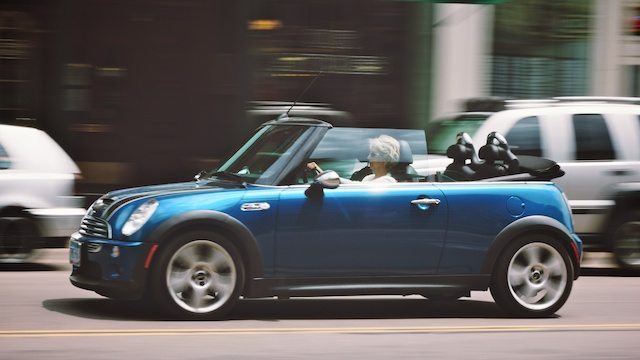
Cooper Mini – f18, 1/40s

Presenting a sense of movement in a photo can really add life to it and that goes very well with street photography. Take the image above. Just standing there watching this Cooper Mini drive by is pretty much a ho hum deal, but blur all of the objects around it and give the wheels some movement and you turn this lady into the one from Pasadena that Jan and Dean used to sing about! Now that’s dating myself! Here’s how I go about taking panning shots. Read More→
Marketing Campaigns for Photographers – The 365 Project

When I think back to my photographic/artistic education the most productive year was my Art and Design foundation course at Wimbledon School of Art. It was a one year pre-degree course in which you spend the first 10 weeks doing 10 different projects in all different areas of art and design before choosing an area to specialise in for the rest of the year. I choose photography in the end but the course also gave me a taster of different areas such as fine art painting, 3D design and sculpture.

The whole year was a relentless pursuit of creativity and 15 years on I still haven’t experienced anything quite like it…….until I started my own 365 project.

Initially I wanted to create something closer to a daily photo project but it evolved into what is now PhotoCreative365

But how is a 365 a marketing campaign I hear you ask?

Your 365 project doesn’t have to last a whole year or even be a photo a day project. What is important is doing something creative everyday that showcases your talents and tunes your skills. Read More→

Starting a Photography Business: Part 45 – A Creative Bubble

It’s a funny old bubble that we creatives inhabit isn’t it?  We are so many characters all with the one aim, to share our talents with others yet some manage this with va va voom and others do so more reluctantly.

Take last week, I was at a flower show and after finishing my photo session I made a beeline for the art tent. Earlier in the morning I’d seen an artist heading over to the marquee head down shyly, hoping no-one approached. We met last year as we have our web designer in common. As I approached his stall last week his back was to any customers with his head down. I empathized with his shyness and walked on by without reacquainting myself.

A couple of stalls along I found a collection of stunning lamps, when you’ve read this check out his site.  http://www.christianwallis.co.uk/ The shapes just made me want to reach out and touch them and run my hands over the smooth curves. In fact I did when Christian’s head was bent writing down some information for me.

Here is the difference, one artist sharing his work with the world whilst his body language said ‘beam me up Scotty’ and the second, was full of enthusiasm and ideas. Even taking the trouble to walk me around the marquee to point out the merits of each stand should I decide to exhibit in the future.

Where do I fall? Somewhere in the middle, give me an inch and I’ll enthuse about my photos, how and where they were taken, mainly the where. Yet I’m always reluctant to offer my photography talents to my friends in case they feel I’m criticizing their work. Read More→

Think More, Shoot Less: by William Petruzzo

I think that photography as an art has taken a pretty big hit since the widespread acceptance of digital cameras. Hipstematic takes an arbitrary picture of a coffee cup taken with an iPhone and turns it into “art”. Bigger memory cards mean there is less and less risk in pressing that shutter button. Like never before, “art” in photography is largely an accident. But is it art at all? I think not.

I define art, not by what is produced, but by what the artist’s mind was doing when it was produced. By that definition, art must be intentional. You cannot simply fire off 10,000 pictures to find those 2 works of “art”. What you found wouldn’t be art at all, it would be a series interesting coincidences. Think about it this way—imagine that you could record everything your eye sees in brilliant high definition and at any point, pull out a single frame and publish it to Flickr. You probably wouldn’t consider that art. Yet this is often what digital photographers do. They point their camera in a thousand directions and find a few images that are interesting enough to share. Anyone can do that.

So, as digital photographers, how do we find our status as an artist? I submit that we find that status by learning to be intentional; by making calculated decisions about the things we photograph; by refusing to press the shutter down before we’re sure that what we’re about it capture is what we intend to capture.

Now, before I move on, let me interject briefly. Photography has a great history of accidentally capturing incredible moments. In fact, some of history’s iconic photos were total accidents.  And that’s okay. Because at that time in history, skilled photographers routinely and intentionally captured beautiful images. And sometimes, they caught beautiful accidents. But it was the exception, not the rule. And that’s part of what made those photos so remarkable. Today, it’s often the other way around. So, while there is a place for incredible coincidences in photography, as photographers we should once again aim to make them the exception, not the rule.

So, in the interest of learning to become true artists, here are six techniques to stretch our intentionality in the creation of our images and heighten the artistic integrity of our work. It’s all about thinking more, and shooting less. Read More→

Scenic Outlook – How to Reinvent Your Vision

It’s easy to get into a routine and stay there. While this usually means you are becoming good at something it also has its consequences. Doing the same thing over and over tends to lose its luster, excitement, and opportunity for growth. We are all about growth, right? Nod your head. Yes, yes we are. The best way to force yourself to grow as a photographer is by giving yourself no choice but to step outside of your comfort zone. This is not entirely about growing and learning new things. It’s also about diversifying your work and opening your and your audience’s eyes to a new take on images.

Photography is heavily gear related. You can only be as creative as your gear allows sometimes and it is especially true in the lens department. If you spend a lot of time reading photography related blogs, I’m sure you have heard people screaming (or typing) from the rooftops proclaiming it’s about your vision, not your gear. To an extent this is true but there comes a point where guess what? Gear matters a whole lot. The biggest game changer to your images is glass. Sweet, sweet glass. Due to varying focal lengths and compression, two images from the same exact location can and will look completely different.

Leave it at home – Are you a heavy wide angle shooter like me? Leave that lens at home next time you go out shooting. Enjoy the telephoto brand of glass? Keep it in the bag and strap on the wide angle. This is hands down the best way to force you to expand your vision and skill. For the remainder of this article, I will pretend everyone out there loves their ultra wide angle lens as much as me. When using a niche lens like an UWA, you tend to compose and frame most shots in a similar fashion. Foregrounds stretch, apparent distances expand, and the sun appears very small. Read More→

Photography 101: How to Break a Photographic Rut

Hitting a photographic slump can happen to even the best photographer. You shoot the same subject matter, process with the same techniques, fill client requests, and work day in and day out doing the same thing. This maybe great for the bank account, but sometimes that can destroy your creativity. Hitting the creative wall can be detrimental to your mood. However, there are some solutions to help break free from this black hole.

One of the easiest things you can do is try something new. This can be anything from shooting different subject matter, processing a photo with a new technique, or even just changing up your normal shooting times. Simply altering one aspect of your photography can not only inspire you, but it may also open your eyes to a completely new photographic world you may not have considered before. Change can be a very good thing!

While we are on the subject of change, why not change up your style for a week. In fact, why not combine several styles into one photo. There are no rules that say you cannot shoot a black and white HDR macro image of a bottle cap. Maybe you want to shoot some long exposure street photography. Again, you are dabbling in something new and foreign, yet that can lead to new tools and personal styles you draw upon at a later time.

Another thing you can do is start some sort of photography project for yourself. Maybe you want to shoot a self-portrait every day for a year, or maybe you roam around your state taking photos of churches. The key to these projects is to make them something that interests you on some deep personal level. When you start to tire of the everyday normalcy and find you just don’t have it in you to press that shutter button, look at your project list and work on some of your personal projects. Read More→