Archive for shooting tips – Page 3

Photography 101: The Rule of Thirds

The rule of thirds may come across as a simple rule, yet it can make a very powerful image. While a lot of photography rules have changed as technology improved, this rule has managed to stand the test of time. Let’s look at this rule and how you can use it to your advantage.

Before I dive into a few of my photos and how I utilize the rule of thirds, a small description is necessary. The idea behind this concept is that you break your scene into threes. An example would be shooting a beach scene. You place the sand in the foreground at the bottom third of the image, the water in the middle third, and the sky in the top third. This rule also applies to the vertical orientation in which you split the scene into thirds in a left to right fashion. Now, let’s look at a few images that utilize this rule.

There are a few ways I framed this image with the rule of thirds in mind. First, I kept the bridge and the vanishing point of the railroad tracks in the lower third of the frame. I also framed the shot so each side of the bridge appears in the lower left and right quadrants of the shot.

Next was framing the trees. While the trees do sneak into the middle portion of the image, I kept the bulk of them on the left and right thirds of the shot. I also tried to keep the trees contained to the bottom two thirds of the frame to allow for some negative space on the top of the shot. This decision ultimately creates a “T” for the fog to fill in, and directs the eyes into the image.

screen-shot-2011-03-25-at-2-35-47-pm

Read More→

Tying The Knot: The Wax On, Wax Off of Wedding Photography

If you want to shoot weddings the best way to start is to become a second shooter, right? But is that really all it takes? You bring your camera to a wedding, stay out of the way of the pro, take  a few nice candid shots of the guests and voila, you’re a wedding photographer! Nah, that’s not the best way.

Ok, I’m not saying it can’t happen like that, but those few shots you take would have to be pretty special for someone to entrust you with their most special day and lots of their hard earned cash. Second shooting is definitely invaluable for building experience; all I’m saying is don’t rely solely on being a dictionary-definition second shooter. Instead you should first aim to be as good as the pro and then second shoot like a pro to make your images much more marketable. So how do you do this with no wedding experience?

Let’s travel back to 1984 and take a look at one of my favourite movies: The Karate Kid. Apart from having one of the best soundtracks of the 80s, it also teaches a simple but important lesson: hard work and preparation pays off.

When Daniel-san spends hour after hour, day after day waxing cars, painting fences and sanding floors he doesn’t see how it’s supposed to prepare him for the impending All Valley Karate Championship. Instead he wants to learn the glamorous rapid punches and spin kicks he sees in the dojo and thinks that copying the routines in his karate text books will turn him into a black belt.

We know, of course, that all those seemingly unrelated tasks actually disciplined Daniel-san in exactly the skills he needed; he just didn’t realise it at the time. Read More→

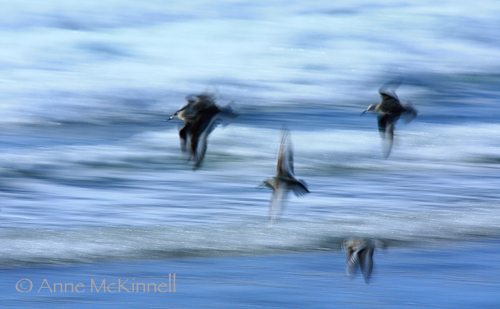
Creating Abstract Impressions: by Anne McKinnell

Impressionist painters were more concerned with colour than line. Their goal was to leave the viewer with an impression of the scene rather than a literal depiction and their works often included a sense of movement.

Photographers can also create emotional abstracts that leave only an impression of the original subject by using a slow shutter speed, from 1/50 of a second to 1/2 second, and moving the camera while the shutter is open or allowing a moving subject to pass in front of the camera.

This technique is fun because every frame turns out different. An afternoon can easily slip by as if moving on the waves of colour. There are 3 ways of approaching this technique:

1. Pan with a moving subject
When you move the camera while the shutter is open, it is called panning. With a moving subject, you want to pan at the right speed to keep the subject in the frame. Panning on a moving subject with a very slow shutter speed has a drastically different result than panning with a faster shutter speed. A faster shutter will have more sharpness in the subject and show some blur in the background. A very slow shutter speed is more abstract and allows you to really feel the movement while retaining just enough detail in the subject that you can still tell what it is.

1/50 Second, f/18, ISO 100

Read More→

5 Easy Tips to Improve Your Portraits (and they don’t cost a dime)

Often times a portrait photographer does everything right; perfect lighting, great location, correct exposure and flawless composition. However, the photo still comes out flat. Something isn’t right. Smiles are forced, people are uncomfortable and the emotion is just not there. The fact is, if you’re photographing people don’t forget about the most important part – the people. When was the last time you were in front of the camera? Do you remember how that felt? If not, please ask someone to take your photo and come back to this post after you’re done. The bottom line is that being in front of the camera can be rather difficult and stressful for some people and it’s our job as photographers to make them feel at ease so that they in turn will look better in the image. Here are five tips to improve your attitude (and in turn your portraits):

  1. Don’t put the blame on the subject – remember that your attitude is everything and it’s only your attitude that you can control. Consciously or not, people will sense if you are angry, annoyed or uneasy in any way so check the grump factor at the door. If you’re photographing children or pets your attitude is even more important because both of these will immediately sense your frustration and then you might as well pack up and go home.
  2. Take the time to talk to (and listen to) your subject (yes, even works with pets). Show an honest interest in them. If you have serious disdain for whatever you are photographing please consider another line of work before you take on something that will only lead to disappointment. Read More→

Breaking Photography Rules: by Scott Wyden Kivowitz

Photography rules exist to follow, and then break. There is no reason to stick with them 100% of the time but they make for a great guideline. Rule of thirds, Horizons, Diagonals, Leading are just some of the types of rules. Read them study them and then don’t be afraid to break them. It is as simple as that.

After you understand light and composition it is time to break some rules. Read More→