Archive for Make Better Photographs – Page 35

Exploring A Ghost Train

Two Train Cars

Along US Route 209 in Hurley, New York, sits a series of railroad coaches and freight cars. These were the same cars that used to travel the Ulster and Delaware Railroad throughout the Catskills during the early tourism days.

Railroad To Hell
This section of track shows the effect years of disrepair and neglect can have on a railroad line.  The good news is that the rail cars will likely not be going anywhere anytime soon. Read More→

Making your first HD DSLR Video – Part I – Training

One of the things you have to consider when attempting to create your first HD DSLR video is knowledge. What do you need to know and where can I find that knowledge? Well, to summarize why I’m even asking, let me give you the premise for this series.

It’s been more than two years now since the release of the Canon 5D Mark II and Vincent Laforet’s film Reverie, which really blew everyone’s doors off. For some, the camera was the greatest thing to hit their lives and they ran with it. This series is for the rest of us who bought these cameras and did little if anything with their film-making capabilities.

I know that I had all these grand ideas about what I would shoot when I just figured out how to use it. The more people I interviewed about it for the LensFlare 35 podcasts, the more daunting it became for me personally. I quickly found out that all the settings I had used to capture those first video segments were ‘wrong’. Then, I started hearing about all this extra gear I needed just to shoot video, THEN it was the fact that I needed assistants, had to change out the type of lighting I owned, had to ‘think’ like a film-maker and storyboard everything out first; I needed a more powerful computer AND expensive software to edit it and…did I mention audio? How important it is to have the correct gear, how to record it, how to sync, it, and on and on. Read More→

Tools for Your Photography Business – Studio Portrait Photographers

This is the forth in our series looking at essential tools for your photography business. We’re going to be looking at some of the essential tools you’ll need to acquire in at least the first year (if not the first month) of your business.

Other articles in this series –

Part 1 – Software and Online Presence

Part 2 – Financials

Part 3 – Wedding Photographers


Part 4 – Studio Portrait Photographers

We’re going to look at two recommended setups for portrait photographers with the first being a basic studio setup. Next week we’re going to be concentrating on location portrait photographers.

Depending on what you specialise in might change what set-up you have but really only in regards to the props you use. I’m going to concentrate on the things you’ll need for nice and simple family portraits……. that doesn’t mean a white background….. I’ve said it before and I’ll say it again……. it’s not 2005 anymore!

The most basic (and yet extremely versatile) setup I can think of …..

  • 2 lights and a large soft-box
  • Grey paper background
  • 4 stands (x2 for background x2 for lights)
  • Coloured Gels

Obviously you’ll need a camera and some way to trigger the light but this can be done with sync cord if radio triggers are a little out of your budget.

The whole point of this set-up is that it can be assembled anywhere. You don’t have to own a studio to take studio portraits.

A grey background can be changed easily by using the coloured gels (and one of the lights).

Taking it to the next level
Obviously this sort of set-up isn’t one you’ll want to be using forever so we’re going to look at a slightly more advanced set-up (and one I would recommend when consulting with any family portrait studio).

Camera and Lights
To be honest we’re back to the old “it’s what you can afford debate” but when it comes to lighting you get what you pay for. Bowens always leaps to mind but if that is a bit out of your budget then Elinchrom or Interfit both make nice lights.

Cameras, I’d be happy shooting family portraits with a 5DMkII or something similar.

Lenses
Prime lenses are nice to have but if you’re shooting kids then don’t underestimate the usefulness of a 24-70mm zoom!
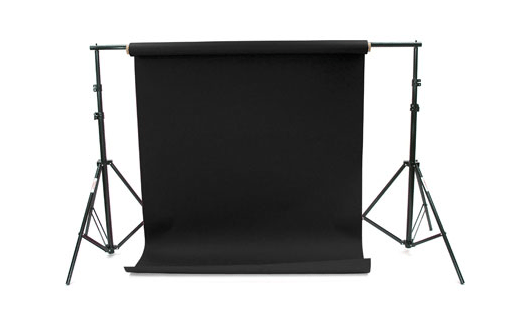
Backgrounds
I like paper backgrounds because they’re cheap and come in hundreds of lovely colours! depending on the space you’re working in or what you’re offering you’ll have to decide on whether your backgrounds are going to be wall mounted or free standing the the picture above.

Whatever option you go for don’t skimp of the cost as you don’t want these bad-boys falling on a 2 year old’s head!

The Giotto Background Support Set or Lastolite Heavy Duty Background Support System should do you for a free standing option.

I always like to have plenty of colours but the essential kit would have to be a green chroma key, black, white and grey.

Lighting control
Lots of fun things to buy in this section and you’ll obviously have to buy what fits your kit, but here’s my basic kit recommendation:

  • 2 Umbrellas Silver/White
  • 2 Wide angle reflectors
  • A snoot with grid set
  • A honey comb grid set
  • 2 sets of barn doors
  • 2 backlight reflectors
  • 2 large soft boxes (bigger the better)
  • 2 large reflectors (the 5-1 types offer good value)
  • Coloured Gels

Couple of other things which are nice to have…..

Radio triggers – you don’t need a massive range or ETTL functions if you have a …..

Light meter – to be honest you don’t have to spend hundreds on one of these…. just get one that works!

Adjustable stools – I love ’em!

A set of wooden boxes – very handy

A step ladder – extremely handy

Wind machine – gimmicky but fun

Props

I’ll leave this to you …… 😉
 

Abandoned Train Depot

Stamford, New York, located in Upstate New York, was a major tourist and vacation destination at the turn of the century.  In the early part of the 20th century, Stamford reached its peak in the tourism industry.  The advent of the automobile and modern advances in long-distance transportation such as commercial jetliners contributed to the decline of tourism and vacationing in the Stamford area.

Abandoned Train Depot - Full View

Some grunge-style photography is not only for artistic reasons, but sometimes can serve as a historical record.  Sadly, many of the abandoned places I have had the opportunity photograph did not remain in existence for very much longer afterward.  The photos used in this article are part of this Abandoned Train Depot set on Flickr. Read More→

Key Reasons To Bring Along a 2nd Shooter To A Wedding

When I first started out I did not shoot my own weddings. I was highly inexperienced and the thought of doing a wedding on my own was just daunting. To be able to move quickly, adjust my camera as necessary and still get the important shots was just too much to concentrate on in the fast paced environment of a wedding. What I did do though was a lot of 2nd shooter jobs. A 2nd shooter is a great tool to have as a wedding photographer. They allow you to take the informal photos that you want to capture that help create beautiful portfolios.

Weddings can go buy quickly, they really can. They may seem to last forever for a guest but for a professional wedding photographer trying to capture all of the important parts of a wedding it can go extremely quick. Having a 2nd photographer or 2nd shooter come along with you to an event solves several issues that you will face. The first is that it frees up your time.

With the 2nd shooter you can have them follow the bride and groom around during the event, ensuring that they are capturing the moments that they are sharing with their guests. This frees you up to take those informal and photojournalistic photos that our clients love to have. It allows you to take a little more time to be creative with your art. When you are by yourself many times you have to forgo the creative side and just be sure you “get the shot”. Read More→

Photography 101: What Is Your Photographic Voice?

I am going to venture down my road of experience once more. This time I am taking on a question that many people asked me when I was first walking down the road of photography. That one dreaded and ridiculously tough question is what is your voice?

When I first took up a camera, I was a happy man behind the lens. I took photos of everything and anything. Dogs, birds, plants, the ceiling, my toes, and whatever else I could finagle into my viewfinder all became my subjects. Then I decided I wanted to make a living of this, and the first question I received repeatedly was what my specialty/angle/voice was. To this question, I always answered, “ummm, good question.” So how did I finally come to answer this? It was not easy lemme tell ya.

The first part to finding your voice is to pinpoint the style of photography you like. Style is different from voice as style is the genre. Your style might be nature, animals, portraits, sports, architecture, or any of the other umpteen dozen styles that exist. For me, I found I really enjoyed macro, grunge, HDR, and landscapes. Keep in mind these don’t all really fit together as one cohesive style. I was able to finally pinpoint this by simply paying attention to the images I spent the most time gawking at. Read More→