Archive for Shooting Tips – Page 2

Think More, Shoot Less: by William Petruzzo

I think that photography as an art has taken a pretty big hit since the widespread acceptance of digital cameras. Hipstematic takes an arbitrary picture of a coffee cup taken with an iPhone and turns it into “art”. Bigger memory cards mean there is less and less risk in pressing that shutter button. Like never before, “art” in photography is largely an accident. But is it art at all? I think not.

I define art, not by what is produced, but by what the artist’s mind was doing when it was produced. By that definition, art must be intentional. You cannot simply fire off 10,000 pictures to find those 2 works of “art”. What you found wouldn’t be art at all, it would be a series interesting coincidences. Think about it this way—imagine that you could record everything your eye sees in brilliant high definition and at any point, pull out a single frame and publish it to Flickr. You probably wouldn’t consider that art. Yet this is often what digital photographers do. They point their camera in a thousand directions and find a few images that are interesting enough to share. Anyone can do that.

So, as digital photographers, how do we find our status as an artist? I submit that we find that status by learning to be intentional; by making calculated decisions about the things we photograph; by refusing to press the shutter down before we’re sure that what we’re about it capture is what we intend to capture.

Now, before I move on, let me interject briefly. Photography has a great history of accidentally capturing incredible moments. In fact, some of history’s iconic photos were total accidents.  And that’s okay. Because at that time in history, skilled photographers routinely and intentionally captured beautiful images. And sometimes, they caught beautiful accidents. But it was the exception, not the rule. And that’s part of what made those photos so remarkable. Today, it’s often the other way around. So, while there is a place for incredible coincidences in photography, as photographers we should once again aim to make them the exception, not the rule.

So, in the interest of learning to become true artists, here are six techniques to stretch our intentionality in the creation of our images and heighten the artistic integrity of our work. It’s all about thinking more, and shooting less. Read More→

3 Ways of Connecting with Your Subject

We just returned from our 2011 senior portrait conference (spa) in Palm Springs California. We had our 3rd model winner in a row from across the country and she won the Top Model award! We are so proud of Kristen!

2011 Senior, Kristen

There were some great images out at spa but this year I “observed” a lot more than I have in the past. We followed Kristen and her mom around on day #3 of spa where she has session with other photographers to see them work and teach.

One of the things that spa celebrates is the best of the best in high school senior photography. And the best of the best senior photographers are all there. A consistent theme that I saw with these photographers was the “connection” they made with the subject, the speed at which they connected with them, and the ease in which they did so. This, of course, translated to a an incredible experience for all the seniors chosen to attend, the photographers, and allowed for some gorgeous images to be created. Read More→

The Myth of the Non-Manipulated Image

Surfing through various internet forums recently, I have noticed an argument that has resurfaced. This argument revolves around what people consider a manipulated image. We have all seen bad manipulations done for magazine covers, news articles, and even the odd internet article. Yet, this debate goes even further than simply removing a stray hair or masking out an unwanted building.

If we look at two of the extreme ends of this debate, there is the camp that wants photos right out of the camera with no post processing what so ever. The other end are those folks who don’t mind using tools like Photoshop, Nik Software, Photomatix, or even Picasa to modify their images in some form or another. Regardless where you fall in this spectrum, I would argue that we are all manipulating the image the moment we click the shutter button.

Why do I believe this? The simple fact is that no camera, no matter how technologically advanced, have the capabilities to capture what our eyes see and our minds interpret. We may try our hardest to reproduce what we are seeing with out eyes, but the fact is we are merely creating an interpretation. So where does the manipulation come in with the shutter click? It comes from the settings, extra lighting, and even filters we use to manipulate what the camera catches.

Here’s a simple example. You are shooting a beautiful tree at sunset. Your eyes are quickly adjusting between the lights and darks of the scene. You must carefully choose how you will expose this scene for your camera. So you dial in a specific shutter speed, aperture setting, and ISO level. You may add a graduated neutral density filter to help keep the sky in correct exposure with the ground. There might even be a polarizer filter added to help bring out more colors. All of these items may help you get the desired end result of a gorgeous image, but it is all stuff you are using to manipulate what appears on the memory card/film. Even specific films can be used to modify how a scene turns out. Read More→

Creating Abstract Impressions: by Anne McKinnell

Impressionist painters were more concerned with colour than line. Their goal was to leave the viewer with an impression of the scene rather than a literal depiction and their works often included a sense of movement.

Photographers can also create emotional abstracts that leave only an impression of the original subject by using a slow shutter speed, from 1/50 of a second to 1/2 second, and moving the camera while the shutter is open or allowing a moving subject to pass in front of the camera.

This technique is fun because every frame turns out different. An afternoon can easily slip by as if moving on the waves of colour. There are 3 ways of approaching this technique:

1. Pan with a moving subject
When you move the camera while the shutter is open, it is called panning. With a moving subject, you want to pan at the right speed to keep the subject in the frame. Panning on a moving subject with a very slow shutter speed has a drastically different result than panning with a faster shutter speed. A faster shutter will have more sharpness in the subject and show some blur in the background. A very slow shutter speed is more abstract and allows you to really feel the movement while retaining just enough detail in the subject that you can still tell what it is.

1/50 Second, f/18, ISO 100

Read More→

Two Methods for Approaching High Contrast Scenes: by Anne McKinnell

One challenge photographers continually face is dealing with high contrast scenes.

Typically there are a couple of choices: you can expose for the highlights and let the shadows go black, or you can expose for the shadows and let the highlights blow out. Neither of these options give great results.

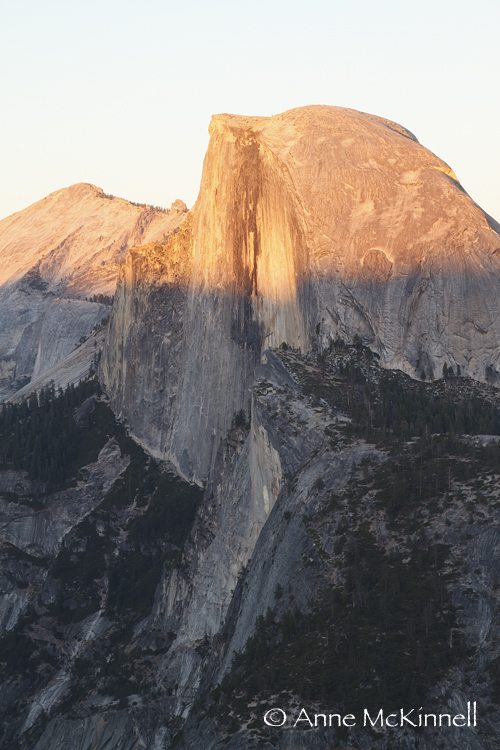
I was faced with an extreme version of this challenge during a recent trip to Yosemite Park in California. Going out at sunrise and sunset to catch the sweet light, I found the valley floor in complete darkness unless the sun was high in the sky.

Here is an example of the type of photo you might come home with in these conditions. The sun was setting on Half Dome lighting up the top of the dome and leaving the valley in darkness.

Half-Dome-1

Read More→

Breaking Photography Rules: by Scott Wyden Kivowitz

Photography rules exist to follow, and then break. There is no reason to stick with them 100% of the time but they make for a great guideline. Rule of thirds, Horizons, Diagonals, Leading are just some of the types of rules. Read them study them and then don’t be afraid to break them. It is as simple as that.

After you understand light and composition it is time to break some rules. Read More→